





Focusing is a practice that teaches you to notice subtle signals in your body—like a tightness in your chest or a flutter in your stomach—as they happen. By pausing and creating space for these sensations, you allow your inner wisdom, or ‘felt sense’, to emerge, offering new insights, emotional relief, and a clearer path forward.
Focusing is based on neuroscience, lived experience, and gentle attention. It helps you stay balanced, process emotions, and listen deeply to yourself, whether you’re practicing alone, outdoors, or with a partner.
You do not need to analyse, relive, or force anything. In Focusing, you simply observe your experience as it is. Change unfolds naturally when you approach it with curiosity, like noticing how a deep breath can shift your mood or how a quiet moment can reveal a solution to a problem.
We live in a time of demands, chronic stress, disconnection, and overwhelm. Stress causes us to lose contact with who we are and how we want to be in life. Mental Health is under strain because we have lost the rituals of deeper community and pacing of the rhythms of life and our true nature. Focusing helps restore contact with the body’s own rhythm, our adaptive strategies, and inner guiding wisdom.
By paying gentle attention to our bodily sensations and our ‘felt sense’, we create a peaceful and non-judgmental inner space that allows us to disidentify from stuck parts and hold them with compassion.
Focusing helps practitioners create a safe space for clients. This supports their shift from survival mode to regulation and integration. Practitioners guide clients to pause, notice bodily sensations, and let images or words arise naturally.
Focusing teaches us empathic listening. We learn to not just hear a child’s words but sense the emotional truth behind them. Children can learn focusing techniques to pause and identify how something feels in their body.
In a business environment, Focusing helps teams move past fear-driven reactions and reconnect with clear thinking. Leaders and team members can use it to make smarter decisions, come up with creative solutions, and handle workplace conflicts more effectively.
You will be guided to develop both self‑Focusing and Focusing partnership skills, so the practice becomes something you can rely on in your personal life, in your interaction with others and your professional context.
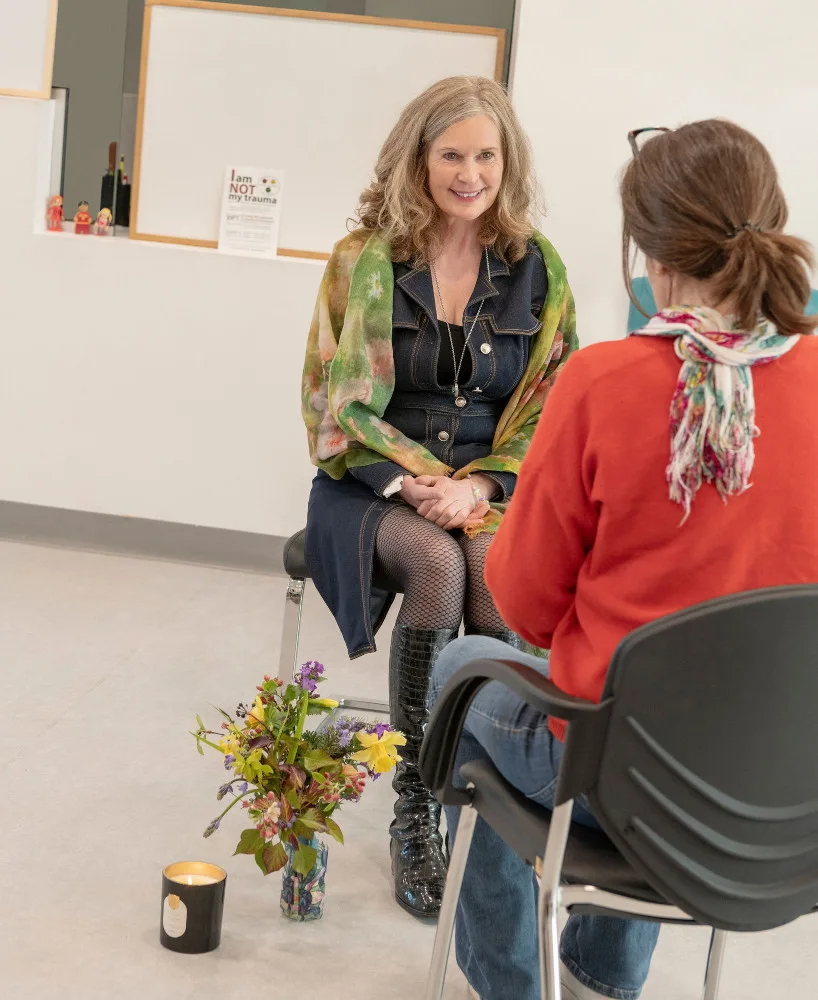
I also offer individual Focusing sessions. In a safe and respectful space, you can build mind-body awareness, process complex emotions and relieve stress. Learn more
I’ve started focusing with Deirdre in January. It’s has changed the way I respond to my body and my emotions . It’s about holding all my parts . When I am focusing “part of me is…..“ it’s not the whole of me.
Its very gentle way to spend time following my body with out get consumed by my emotions. Also the schools where my children go have commented on how much more regulated they are. I don’t need any more proof focusing is changing my family life for better.
A gentle entry point into Focusing — no prior experience required. Learn how attention, presence, and the felt sense support regulation and clarity.